

Imagine converting 30% more leads without adding headcount.
That’s the promise of marketing automation: a strategic system of interconnected workflows and tools that streamlines repetitive tasks, deepens engagement, and delivers measurable ROI.
In the B2B world—where prospects typically need 8 digital touchpoints before a meeting—manually reaching each contact is impossible. Let’s unpack how marketing automation works, explore core workflows, spotlight top platforms, and share a step‑by‑step guide to kickstart your automation journey.
Why Marketing Automation Matters for B2B Growth
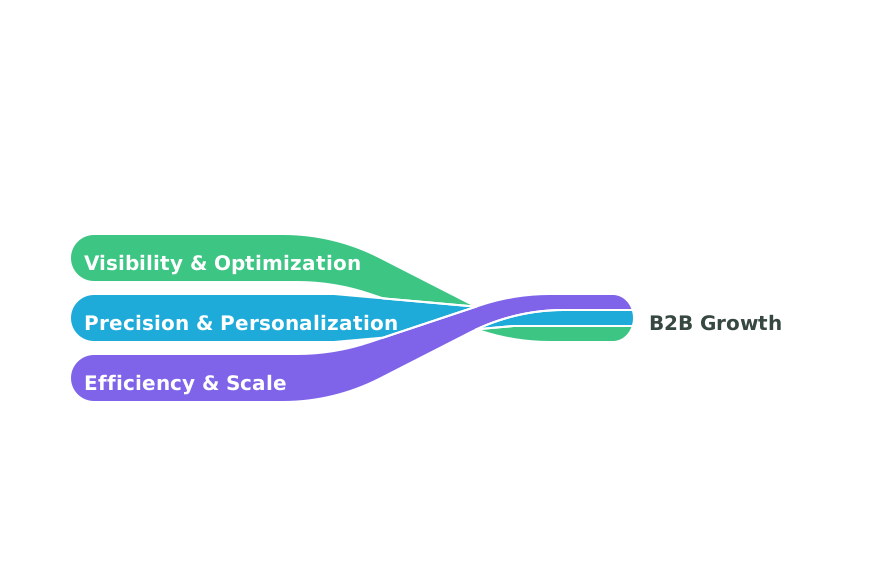
Efficiency & Scale
Manual follow‑ups, data silos, and time‑consuming reporting hold teams back. Automation reduces repetitive tasks—from email sends to lead scoring—so your marketers focus on strategy and creative work.
Companies leveraging automation see a 451% increase in qualified leads, freeing resources for high‑impact activities.
Precision & Personalization
Generic blasts no longer cut it. Trigger‑based campaigns and real‑time segmentation let you deliver the right message at the right moment.
Whether it’s a behaviour-driven email or a dynamic landing page, personalisation at scale boosts engagement and trust.
Visibility & Optimization
Gone are the days of guessing ROI.
Dashboards track funnel velocity, campaign performance, and pipeline impact in real time.
Automated alerts notify sales when high‑value prospects hit key pages, ensuring no opportunity slips through the cracks.

Suggested reading:
What Is DevOps and Why Your Business Needs It: The Complete Guide to DevOps in 2025
Core Marketing Automation Workflows You Need
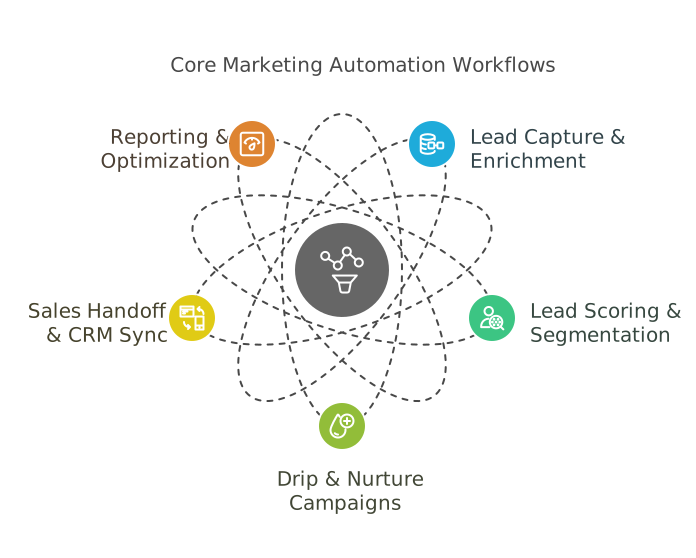
Lead Capture & Enrichment
Efficient lead capture starts the moment a visitor interacts with your brand—whether that’s submitting a form, chatting with a bot, or downloading gated content.
As soon as a trigger fires (form submission, chatbot interaction, content download), your system auto‑captures every data point and instantly enriches the profile via third‑party APIs like Clearbit. This ensures your database stays up to date and actionable.
Key Metrics: Form conversion rate, data completeness
Lead Scoring & Segmentation
Not all leads are created equal. By tracking behaviours—page views, email opens, content downloads—you can assign dynamic scores that reflect each prospect’s engagement and fit.
Once scored, leads are auto‑segmented into lists tailored for targeted messaging, ensuring your most promising contacts receive the right nurture at the right time.
Key Metrics: MQL conversion rate, average lead score
Drip & Nurture Campaigns
Whether you choose time‑based sequences (e.g., a welcome series) or trigger‑based journeys (e.g., follow‑up after webinar attendance), automated drips keep prospects moving through your funnel.
Personalisation tokens and dynamic content blocks allow each email or landing page to speak directly to the recipient’s needs and behaviours.
Key Metrics: Open rates, click‑through rates, stage progression
Sales Handoff & CRM Sync
When a lead’s score crosses your predefined threshold or they engage with high‑intent assets, the workflow automatically creates tasks, sends notifications, and updates CRM records in platforms like Salesforce or HubSpot.
This seamless handoff guarantees that sales follows up within your SLA, turning warm leads into qualified opportunities.
Key Metrics: Lead response time, SQL conversion rate
Reporting & Optimization
True automation isn’t “set and forget.” By generating real‑time dashboards in tools like Google Looker Studio or Tableau, you can monitor funnel velocity, campaign ROI, and cost per lead at a glance. Continuous A/B testing of subject lines, send times, and content elements feeds a cycle of optimization that maximizes performance.
Key Metrics: Funnel velocity, campaign ROI, cost per lead
This structured, data‑driven approach to marketing automation ensures each workflow not only runs itself but also feeds insights back into your strategy—driving smarter decisions and sustained B2B growth.
Is Your CRM Ready for 2025?
Unify your customer data, automate sales and marketing processes, and deliver personalised experiences that drive revenue and retention. Build a seamless pipeline from prospect engagement to loyal advocacy with our end‑to‑end CRM solutions.
How to Implement Your First Automation Workflow
Step‑by‑Step Implementation Guide
| Step | Description | Key Activities |
|---|---|---|
| Map Your Buyer Journey | Audit current processes to identify all touchpoints and gaps |
|
| Choose a Pilot Workflow | Select a focused sequence to test first |
|
| Configure & Test | Build and validate your workflow in-platform |
|
| Launch & Monitor | Go live and track performance |
|
| Optimize & Scale | Refine and expand once you’ve proven ROI |
|

Suggested reading:
Optimise Your B2B and B2C SEO Strategy for 2025: Google Gemini’s Role in Shaping Search Results
Top Marketing Automation Platforms & Point Solutions
Selecting the right mix of tools can make or break your marketing automation strategy.
Below, we break down leading all‑in‑one suites, specialised point solutions, and analytics add‑ons, along with key criteria to guide your decision.
| Category | Platform & Use Case |
|---|---|
| All‑In‑One Suites | HubSpot Marketing Hub offers an intuitive drag‑and‑drop workflow builder, built‑in CRM, and a generous free tier—perfect for mid‑market teams ramping up email, social, and lead‑scoring campaigns. Adobe Marketo Engage excels at complex, account‑based marketing with deep integration across the Adobe Experience Cloud, making it the go‑to for enterprises with sophisticated multi‑channel programs. While HubSpot scales affordably and onboards quickly, Marketo delivers advanced segmentation and predictive analytics for larger budgets and technical teams. |
| Point Solutions | Drift powers AI chatbots that qualify and route leads in real time, boosting demo bookings by up to 40%. ActiveCampaign blends email automation, SMS, and a lightweight CRM—ideal for SMBs seeking unified nurture and sales processes without enterprise complexity. Zapier connects 7,000+ apps with no code, automating custom workflows like pushing form data into Slack or triggering follow‑up tasks in your CRM. |
| Analytics & BI Add‑Ons | To turn data into decisions, integrate your automation platform with Tableau, or Google Data Studio. Tableau and Looker offer governed, scalable reporting across multiple data sources, while Data Studio’s free, drag‑and‑drop interface makes it easy to build shareable dashboards for real‑time campaign monitoring and A/B test analysis. |
How to Choose Marketing Automation Tools
Ease of Use
Look for intuitive interfaces and pre‑built templates to minimize training time.
Integration Depth
Ensure native connectors to your CRM, ad networks, and BI tools to eliminate data silos.
Scalability
Verify the platform can handle your growing database, additional channels, and advanced workflows.
Pricing Transparency
Compare feature tiers and total cost of ownership, including onboarding and support fees.
By aligning your needs—whether broad-suite functionality, specialised point tools, or deep analytics—you’ll equip your team with the right marketing automation tools to drive measurable B2B growth.
Is Your Growth Engine Fueled by HubSpot?
Harness the power of HubSpot’s all‑in‑one platform to streamline marketing, sales, and service in a single, unified CRM. Automate lead nurturing, personalise every touchpoint, and gain real‑time insights that drive smarter decisions and faster growth.
A Quick Showcase: 25% MQL‑to‑Opportunity Lift in 3 Months
A mid-sized B2B SaaS company offering workforce management software faced a common challenge: leads were entering the funnel, but few were converting into qualified opportunities. The marketing team implemented a lead scoring and nurture workflow using HubSpot, enriched lead data through Zapier integrations, and connected performance dashboards in Tableau.
The pilot campaign targeted demo request leads with automated, behaviour-triggered emails and dynamic content based on industry. Within three months, the company saw a 25% increase in MQL-to-SQL conversion rate, a 30% reduction in time-to-close, and improved sales alignment through real-time CRM updates.
Lessons Learned
- Start with one high-impact workflow, like demo follow-up or abandoned signup nurturing.
- Prioritise clean data and consistent scoring logic.
- Use dashboards to continuously monitor and optimise based on what’s working.
This case shows how marketing automation works when built on data-driven marketing automation strategies—turning intent signals into revenue, faster.
B2B marketing automation is more than a set-it-and-forget-it system—it’s a strategic framework for driving meaningful, measurable growth. When you connect the dots between lead capture, scoring, nurture sequences, and real-time analytics, you create a marketing engine that works around the clock to move leads through the funnel with precision.
The key to long-term success lies in starting with one high-impact workflow—like a demo request follow-up or content download nurture. Use automation platforms that integrate with your CRM, layer in segmentation, and begin measuring what matters: engagement, conversions, and revenue influence. With each iteration, you’ll learn, optimise, and scale.
So, what’s next?
Choose your pilot workflow, set your KPIs, and begin building with the right tools in place. By aligning strategy, technology, and insight, you’ll explore full potential of automated B2B lead nurturing—turning marketing from a cost centre into a predictable growth driver.
Discover how the right mix of tools and data‑driven strategies can deliver scalable lead nurturing, higher conversion rates, and rock‑solid alignment between marketing and sales.
Activate Your Automation Strategy Today.