



Over 90% of B2B companies rely on CRM systems, yet fewer than half see clear revenue impact. The problem isn’t adoption. It’s the gap between what the CRM can do and how it’s actually implemented to support complex sales cycles, remote selling, and accurate revenue forecasting.
You’ll get a practical roadmap for CRM customization that aligns with your Ideal Customer Profile, automates manual work, improves forecast reliability, and boosts conversion rates stage-by-stage. These are the same optimization strategies driving up to 3× pipeline growth and significantly stronger sales performance for modern B2B teams.
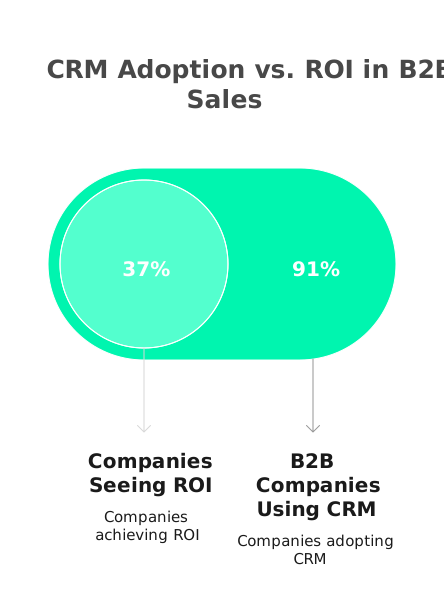
Why 91% of B2B Companies Use CRM But Only 37% See ROI: Understanding the Adoption Gap
CRM adoption is nearly universal in B2B sales, yet most companies still struggle to prove ROI. With the CRM market projected to reach $78.6–$112.9 billion by 2025, the gap isn’t about technology, it’s about customization and alignment with real sales processes. When CRM systems are properly configured, teams achieve up to 29% higher sales productivity and better revenue outcomes.
The Hidden Cost of Poor CRM Configuration
When CRMs aren’t tailored to the ideal customer profile or actual sales workflows, reps spend more time fixing data than closing deals. This leads to slow adoption, inaccurate forecasts, siloed spreadsheets, and critical deal information slipping through the cracks. The result isn’t just wasted technology budget, it’s lost pipeline and preventable revenue leakage.
What Top-Performing CRM Teams Do Differently
The successful 37% share three traits:
- CRM configured to match real sales stages and required field data
- Ongoing role-based training and change enablement
- Continuous data hygiene with ownership and automation
These teams build CRM systems reps actually want to use enabling automation, clean data, accurate forecasting, and consistent pipeline growth.

Suggested reading:
Reducing Human Error: Business Process Automation Benefits for Data Accuracy
AI-Powered Automation: Reducing Manual Tasks and Boosting Sales Efficiency by 25–29%
65% of companies now use generative AI in CRM to automate sales tasks and results show a 25–29% boost in efficiency for B2B teams. Manual admin is the biggest productivity blocker: data entry, follow-ups, scheduling, and reporting. AI automation gives reps 10–15 hours back per week to focus on selling.
With an average 245% CRM ROI, high-impact automation includes:
- Automated playbooks for follow-ups and renewals
- Real-time insights and coaching
- AI-powered lead scoring and prioritization
Conversational AI Assistants and Automated Playbooks
Conversational AI handles follow-ups, meeting scheduling, reminders, and data syncing. Automated playbooks trigger actions based on buyer activity, ensuring instant responses, faster routing, and zero missed touchpoints.
AI-driven coaching delivers real-time suggestions during calls: best messaging, similar deals, and next-best-actions. This ensures consistent, high-quality buyer experiences that convert more opportunities.
Predictive Lead Scoring and Real-Time Prioritization
Predictive scoring uses behavioral and firmographic signals to show reps who to call first, boosting high-intent conversations by up to 68% and cutting sales cycles by 20–30%.
Real-time scoring updates continuously based on buyer engagement, helping reps avoid low-value pursuits and focus directly on leads most likely to convert.
Implementing AI Workflows Without Replacing Your Entire System
You don’t need a full CRM replacement. Modern AI tools integrate with existing systems like HubSpot, and Salesforce using APIs and native connectors.
Start small with:
- Automate follow-ups
- Add predictive scoring
- Scale into conversational AI
With flexible licensing and modular rollout, teams adopt AI faster, without disrupting current workflows or infrastructure.
Is Your CRM Holding Back Your Sales Team?
Generic configurations slow reps down and create data chaos. We tailor Microsoft Dynamics CRM to your exact B2B sales process — smarter workflows, automated follow-ups, clean data, and full visibility across every account.
Improving Sales Forecasting Accuracy by 34%: Revenue Intelligence and Embedded Analytics
Inaccurate forecasting is costly in B2B sales. CRM revenue intelligence improves forecasting accuracy by 34%, enabling precise planning and predictable growth.
Embedded analytics inside CRM assess pipeline health, deal velocity, and win rates to forecast outcomes instead of guessing. With the predictive analytics market projected to reach $28.1B by 2026, accurate forecasting has become essential for managing B2B sales with CRM, from hiring to inventory and revenue planning.
Real-Time Insights and Visual Pipeline Management
Visual pipelines replace spreadsheets with clear deal visibility – stage, value, risk, and next steps. Bottlenecks become obvious and teams respond faster.
Enhanced CRM tracking ensures every interaction like emails, calls, meetings is captured for complete deal context. AI insights detect winning patterns, like messaging or timing that accelerates closing, while real-time coaching improves rep performance continually.
Forecasting Methodologies for Complex B2B Sales Cycles
With 6–18 month B2B cycles and multiple stakeholders, traditional forecasting breaks down. 77% of B2B buyers report complex purchasing so forecasting must account for buying-committee dynamics.
We implement stage-based forecasting tied to historical conversion rates (ex: 10% at qualification → 80% after legal review). CRM configuration also tracks stakeholder sentiment and influence to provide a true deal-health score, not just a probability label.
90-Day CRM Implementation Roadmap for B2B Sales Teams
| Phase | Timeline | What Happens | Key Deliverables | Success Metrics |
|---|---|---|---|---|
| Discovery & CRM Selection | Days 1–30 |
|
|
|
| Data Migration & Configuration | Days 31–60 |
|
|
|
| Training & Adoption Optimization | Days 61–90 |
|
|
|

Suggested reading:
Everything You Need to Know About CRM Automation Reporting in 2025: Turn Your Data into Actionable Insights
Remote Sales Team Enablement for Digital-First B2B Sales
Modern buying is digital-first, and B2B sales with CRM must empower remote and distributed teams to sell effectively from anywhere. Visibility, data quality, and real-time collaboration are the foundation of this shift.
The right CRM setup provides:
- Mobile-first access + offline capabilities: reps can review accounts, update deals, and log activities instantly, even without a stable connection.
- Integrated communication tools: syncing CRM with platforms like Teams, Slack, and Zoom keeps messages, meetings, and documents tied to every deal.
- Centralized visibility: managers gain clear insights into pipeline health, rep performance, and sales activity without physical oversight.
Together, these capabilities transform remote selling from a challenge into a competitive advantage, making CRM the single source of truth for digital-first B2B sales teams.
KPIs to Track for Remote Sales CRM Success
- Lead Response Time
- CRM Usage & Activity Logging Rates
- Pipeline Velocity and Deal Age
- Forecast Accuracy
- Win Rate by Segment and Channel
- Time Saved through Automation
- Sales Cycle Length Reduction
Emerging Trends: AI-Powered B2B Sales with CRM
AI is rapidly reshaping how B2B sales with CRM operates. Intelligent automation, predictive analytics, and unified data ecosystems are moving from “future plans” to everyday reality.
CRMs are evolving into:
- Proactive systems predicting buyer intent and next actions
- Always-on assistants supporting reps in real time
- Unified data hubs that remove siloed customer information
The takeaway?
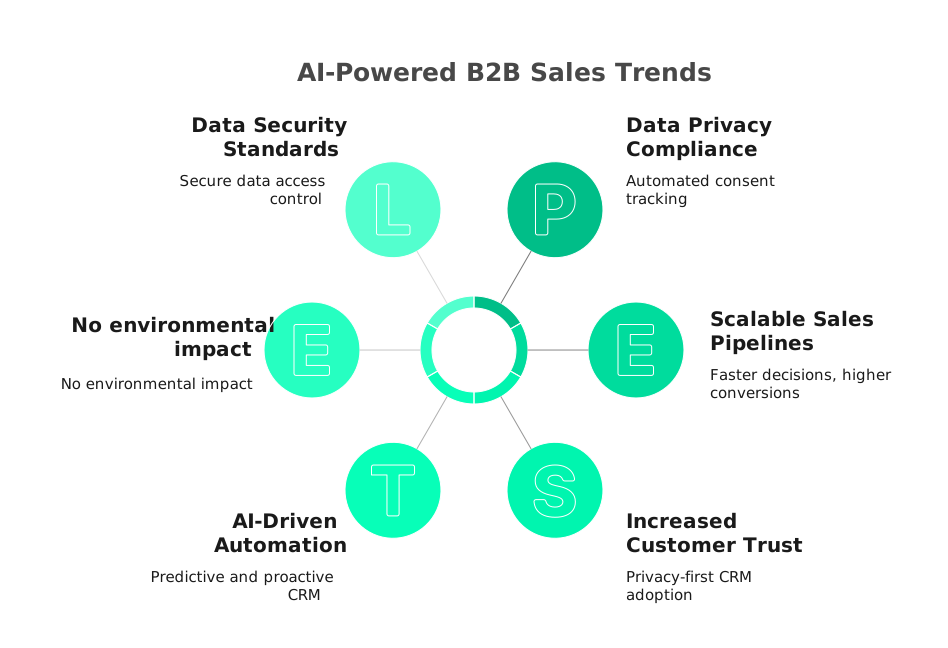
Companies that adopt AI early gain faster decisions, higher conversion rates, and more scalable pipelines.
Generative AI & Autonomous Sales Assistants
Modern CRMs now automate high-effort sales tasks, from drafting personalized outreach to qualifying leads and scheduling meetings. AI agents support reps, so humans focus on strategy and relationships rather than admin work.
High-ROI AI features include:
- AI-driven lead scoring + routing
- Predictive forecasting
- Automated workflows + follow-ups
- Conversational AI for first-touch engagement
Together, these features increase efficiency, consistency, and pipeline health.
Privacy-First CRM & Automated Compliance
As data protection laws expand, compliance must be built into CRM workflows. Automated consent tracking, secure data handling, and role-based access protect both customer trust and business risk.
To scale compliant B2B sales with CRM:
- Map and control personal data
- Automate consent + data removal workflows
- Standardize privacy-safe sales processes
Compliance is now a competitive trust advantage.
Is Your Marketing Working While You Sleep?
Automate campaigns, qualify leads, and sync everything with your CRM — so sales gets high-intent opportunities on time, every time.
Turning CRM Into a Revenue Engine
Maximizing CRM ROI is about exploring performance through smarter customization. When B2B organizations embed AI-powered automation, reps reclaim valuable selling time and sales efficiency improves significantly. When revenue intelligence and visual pipeline insights guide decisions, forecasting accuracy strengthens and revenue becomes more predictable. And when CRM configurations reflect real-world complexities, multi-stakeholder deals, long sales cycles, shifting intent, teams gain the clarity needed to prioritize the right opportunities.
The takeaway is simple: most businesses have already invested in CRM.
Few have fully optimized it.
The companies that leverage automation workflows, real-time insights, and tailored forecasting models aren’t just managing pipeline, they’re accelerating it.
As AI capabilities continue advancing moving into 2026, organizations that continuously refine and customize their CRM will be the ones scaling growth with confidence and realizing the ROI their technology was built to deliver.
Transform into a fully customized sales engine with automated, insight-driven, and aligned to the way your team really sells. Stop adapting to the system. Build the system that accelerates growth.

Frequently Asked Questions
What is the best CRM for B2B sales?
There is no one-size-fits-all. HubSpot, Salesforce, and Microsoft Dynamics are top choices because they scale, automate, and integrate well. The best CRM is the one aligned to your sales process, not just the most popular brand.
How does CRM improve B2B sales performance?
A well-configured CRM centralizes data, automates admin work, and prioritizes the right opportunities driving up to 29% higher productivity and 34% better forecasting. It enables faster responses, stronger collaboration, and more personalized selling.
What are the most important CRM features for B2B sales teams?
AI-powered lead scoring, workflow automation, visual pipeline views, multi-stakeholder tracking, mobile access, and integration with marketing and communication tools. For long sales cycles, revenue intelligence is essential.
How long does it take to implement a CRM for B2B sales?
Typically ~90 days using a phased plan with discovery, configuration, and training. Rushed rollouts cause low adoption and bad data; structured implementation accelerates time-to-value.
How can businesses maximize ROI from CRM investments?
Customize around real sales processes, invest in role-specific training, maintain clean data with automation, and integrate your tech stack. Treat CRM as a growth engine, not just software to achieve the full ROI potential.