



The B2B marketing world is about to shift dramatically.
We’re moving from traditional rule-based automation where you set up “if this, then that” workflows, to agent-based CRM systems where AI makes autonomous decisions, executes campaigns, and optimises customer journeys without constant human oversight.
If you’re planning your 2026 technology stack right now, this is no longer an upgrade decision; it’s a fundamental rethinking of how marketing automation works.
But here’s what we’ve learned after working with B2B marketers: the biggest barriers to success aren’t the shiny new AI features. They’re the foundational problems that plague organizations today.
Inaccurate data is causing ineffective campaigns. Sales and marketing teams operating in silos, creating revenue leaks. Unclear ROI measurement is preventing the strategic investment you need. Integration complexity that stalls implementations for months.
This guide is different from the typical “future of CRM” think piece.
We’re combining forward-looking 2026 trend analysis, agent-based CRM, autonomous AI systems, and transparent decision-making with immediately actionable frameworks you can use today. You’ll get ROI calculators backed by real case studies showing 800% revenue increases, platform selection matrices comparing HubSpot, Salesforce, Active Campaign, and others, and implementation checklists that eliminate the guesswork.
We’ll start by understanding how AI evolution is changing CRM automation, then build the data quality and integration foundations that make everything else possible. From there, we’ll tackle sales-marketing alignment with proven frameworks, show you exactly how to measure ROI with specific metrics, and help you select the right platform for your business size and needs.
The 2026 CRM Automation Landscape: From Traditional Workflows to Agent-Based Intelligence
The automation you’re using today, even if it’s sophisticated, operates on predefined rules. A lead downloads a whitepaper, so they enter a nurture sequence. A contact reaches a certain score, so they’re routed to sales. These are powerful workflows, but they’re fundamentally reactive and static.
Agent-based CRM systems flip this model. Instead of waiting for you to define every possible scenario, AI agents analyse context, predict outcomes, and autonomously execute the optimal action for each individual prospect. We’re talking about systems that don’t just follow your playbook, they write new plays in real-time based on what’s actually working.
This shift is happening right now. HubSpot’s AI features, Salesforce Einstein, and Microsoft Dynamics 365 AI agents are already implementing early versions of this technology. But 2026 is the inflection point where these capabilities move from “nice to have” to “table stakes” for competitive B2B marketing.
What Makes Agent-Based CRM Different from Traditional Automation
Let’s make this concrete.
With traditional automation, you might set up a rule: “If a lead opens three emails and visits the pricing page, increase their score by 20 points and notify sales.”
That’s conditional logic, and it’s valuable.
Agent-based CRM takes a different approach. The AI analyzes thousands of signals email engagement, website behavior, company firmographics, industry trends, similar customer patterns and determines that this specific lead is 87% likely to convert in the next 14 days. It doesn’t wait for your predefined threshold. Instead, it dynamically adjusts the nurture cadence, personalizes the next email’s content using generative AI, and routes the lead to the sales rep who’s historically most successful with this company profile.
The difference?
Traditional automation executes your strategy.
Agent-based systems optimize and adapt your strategy continuously.
We’ve seen this play out in account-based marketing strategies for complex B2B sales cycles, where AI-powered targeting delivers 97% higher ROI than manual approaches.
Nested workflow automation is the bridge between these two worlds. It’s the ability to create multi-layered decision trees where each step considers the outcomes of previous steps and adjusts accordingly. Think of it as automation that learns and responds, rather than just executing a linear sequence.

Suggested reading:
CRM Marketing Automation: A Complete Guide to Streamline Your Sales and Marketing
Key AI Capabilities Defining CRM Platforms in 2026
When you’re evaluating platforms for 2026 readiness, here are the AI capabilities that’ll separate leaders from laggards:
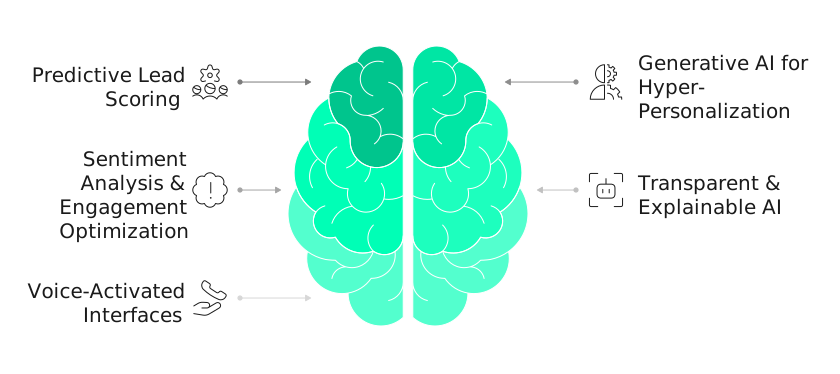
Predictive Lead Scoring
Machine learning algorithms that analyze your historical conversion data, not just demographic fits, to score leads based on actual behavior patterns.
This isn’t manual point assignment; it’s AI that learns which signals actually predict revenue in your specific business.
Generative AI for Hyper-Personalization
The ability to create unique email content, product recommendations, and landing page variations for individual prospects at scale. We’re not talking about mail merge personalization we mean AI that understands context and generates genuinely relevant messaging.
Sentiment Analysis and Engagement Optimization
Real-time tracking of customer sentiment through email responses, chat interactions, and social engagement. The system identifies when a prospect is frustrated, excited, or confused, then adjusts messaging and timing accordingly.
Transparent and Explainable AI
This is critical for compliance and trust. As privacy regulations tighten (GDPR, CCPA, and emerging frameworks), you’ll need AI systems that can explain why they made specific decisions. “We recommended this content because the prospect engaged with similar resources and matches the profile of customers who converted after this touchpoint”. It builds trust and satisfies regulatory requirements.
Voice-Activated Interfaces
Emerging fast for mobile-first sales teams. Imagine your sales reps updating CRM records, logging calls, and accessing insights through voice commands while driving between meetings. It’s already here in early forms, but 2026 platforms will make this seamless.
The best resource we’ve found for understanding how these capabilities work together in practice is this guide on API-first integration architectures for marketing automation, which show how modern systems connect these AI features into unified workflows.
Are Your Campaigns Automated?
Drive engagement and revenue with automated campaigns, lead nurturing, and real-time analytics that ensure every prospect receives the right message at the right time.
Preparing Your Team for the Autonomous CRM Shift
Here’s what we tell every client: the technology is the easy part. The hard part is getting your team ready for a fundamentally different way of working.
User adoption resistance is the top reason automation projects fail. When you’re moving from manual processes to AI-driven workflows, people fear job displacement, struggle with new interfaces, and resist changing established habits. We’ve learned that change management isn’t optional, it’s the foundation of successful implementation.
Start with executive sponsorship. Your leadership needs to articulate why this shift matters, what success looks like, and how it benefits individual team members. Without top-down support, adoption initiatives stall.
Then implement a phased rollout. Don’t flip the switch overnight. Begin with one team or one workflow, prove the value, gather feedback, and iterate. We’ve seen companies achieve 80%+ adoption rates by starting small and building momentum, versus 30-40% adoption with big-bang launches.
Invest in hands-on training, not just webinars. Get your team actually building workflows, interpreting AI recommendations, and understanding how to override the system when needed. The goal isn’t to replace human judgment; it’s to augment it with AI insights.
Finally, establish clear success metrics from day one. What does “good adoption” look like? How will you measure whether AI recommendations improve results? When teams see concrete improvements, faster lead response, higher conversion rates, and less manual work, adoption becomes self-reinforcing.

Suggested reading:
Everything You Need to Know About CRM Automation Reporting in 2025: Turn Your Data into Actionable Insights
Building the Foundation: Data Quality and Integration Architecture for 2026 Success
Every conversation we have with B2B marketers eventually comes back to the same frustration: “Our data is a mess.” Inaccurate contact information. Duplicate records. Incomplete fields that prevent segmentation. Outdated job titles that route leads to the wrong sales reps.
Here’s the truth: all those sophisticated AI capabilities we just discussed?
They’re worthless if they’re trained on garbage data.
Predictive lead scoring that analyzes bad data produces unreliable recommendations. Personalization engines that work from incomplete records send irrelevant messages. Autonomous workflows that sync dirty data between systems create chaos instead of efficiency.
Data quality isn’t a technical problem it’s a business problem that directly impacts revenue. We’ve seen companies waste 20-30% of their marketing budget targeting the wrong people, sending messages to inactive emails, and following up on leads that were never real prospects in the first place.
The second foundational challenge is integration architecture. Your CRM, marketing automation platform, email system, advertising platforms, analytics tools, and customer support software all need to share data seamlessly. When they don’t, you get lead handoff delays, data sync errors, and the dreaded “black hole” where marketing sends leads to sales but nobody knows what happens next.
CRM Marketing Automation 2026: How to Future-Proof Data, Integrations & ROI
Most CRM automation failures don’t start with tools, they start with data.
Dirty, outdated, or inconsistent records sabotage campaigns before they even launch. 30% of your contacts could already be invalid, 20% misclassified, and duplicates might be distorting your reports, draining ROI and credibility.
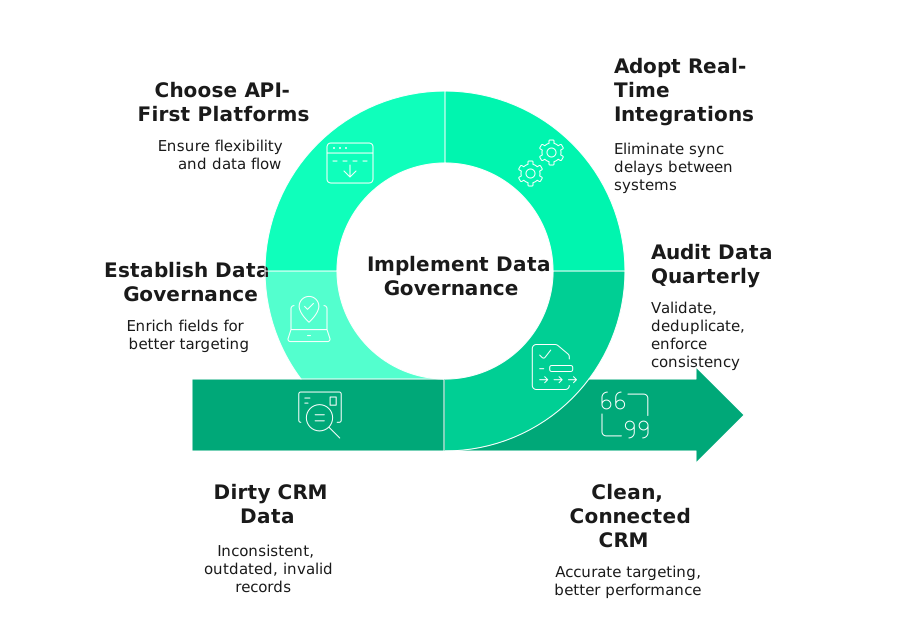
As 2026 approaches, data integrity and real-time system integration will define automation success. Machine learning can’t fix bad data, but in fact amplifies it. Clean, connected, API-driven systems are what make personalization, segmentation, and lead nurturing truly scale.
Here’s how forward-thinking businesses are preparing now:
- Audit and standardize data quarterly – validate, deduplicate, and enforce field consistency.
- Adopt real-time integrations between your CRM and marketing tools to eliminate sync delays.
- Choose API-first platforms to ensure flexibility and bi-directional data flow.
- Establish data governance and enrich key fields for better targeting and automation accuracy.
The outcome?
More accurate targeting, better campaign performance, and automation that scales without breaking under bad data.
How Are You Streamlining Your Sales Outreach?
Enable your sales team with automated follow-ups, integrated CRM lead scoring, and prioritization, ensuring timely and consistent communication with high-value prospects with Salesforce.
Achieving Sales–Marketing Alignment Through Unified CRM Platforms
Sales says the leads are weak.
Marketing says sales are too slow.
The truth?
Disconnected systems and poor visibility cost businesses real revenue.
Companies with aligned sales and marketing teams see up to 38% higher win rates and 36% better retention, all because they share data, goals, and workflows.
A unified CRM platform bridges the gap by giving both teams access to the same information in real time. When a lead comes in, it’s automatically scored, routed, and tracked. No manual exports, no missed follow-ups. Sales sees every marketing touchpoint; marketing sees what happens after handoff.
Even small inefficiencies add up: a 30-minute delay in response time can reduce conversions 9x, while losing just 20% of qualified leads can leak hundreds of thousands in revenue annually.
The fix lies in three pillars:
- Shared Goals – Revenue-based KPIs and joint SLAs align priorities
- Unified Processes – Automated routing and feedback loops eliminate lead loss
- Integrated Technology – Real-time syncs and closed-loop reporting connect every action to results
Modern CRMs also give visibility into entire buyer groups like decision-makers, influencers, and end-users, enabling smarter engagement across complex B2B sales cycles.
By aligning your teams through a single, integrated platform, you don’t just fix communication gaps, but accelerate conversions, improve retention, and drive predictable growth.
Suggested reading:
What is Marketing Automation in CRM and How It Boosts Customer Engagement
Measuring What Matters: ROI Frameworks and Strategic Planning for 2026
Many B2B marketers still struggle to answer a simple question from leadership:
“What’s the ROI of our marketing automation investment?”
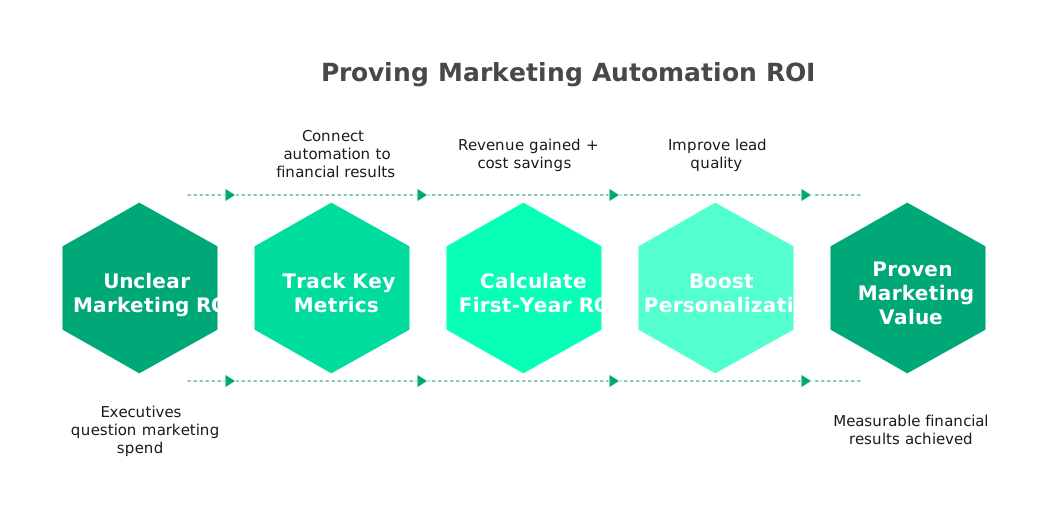
Email sends and social followers don’t justify spend.
Executives care about revenue impact, efficiency gains, and cost savings. Not vanity metrics. Without a clear ROI framework, budgets stall and transformation slows.
The ROI Framework That Matters
ROI = (Revenue Gained + Cost Savings – Total Investment) / Total Investment × 100
Here’s an example:
- Total First-Year Investment: €105,000 (platform, setup, management)
- Incremental Revenue: €903,000 (35% conversion lift)
- Cost Savings: €90,000 (automation efficiencies)
First-Year ROI: 946%
These aren’t projections, as similar results have been achieved by companies using CRM automation to boost personalization, reduce manual tasks, and improve lead quality.
Metrics That Prove Value
Beyond ROI, track metrics that connect automation to outcomes:
- Lead Velocity Rate: Speed of movement through funnel stages
- MQL-to-SQL Rate: Quality of leads passed to sales
- CAC vs. CLTV: Efficiency and long-term revenue impact
- Marketing-Sourced Revenue: Marketing’s direct pipeline contribution
- Lead Scoring Accuracy: Predictive reliability of your automation models
Each metric ties activity to measurable financial results, providing exactly what decision-makers want to see.
Your 2026 Planning Roadmap
Heading into the year, apply this ROI framework to your platform strategy:
- Audit current automation and identify manual inefficiencies.
- Set SMART goals tied to revenue or efficiency.
- Evaluate platforms for AI-driven and agent-based capabilities.
- Forecast ROI across conservative, moderate, and aggressive scenarios.
- Develop adoption and reporting plans that track metrics executives care about.
Companies that begin ROI-based planning now will enter 2026 ready for AI-enabled automation, while others are still trying to justify their budgets.
How Well Connected Is Your Data?
Integrate data from multiple sources into a single platform, providing accurate insights and a unified view of customers to improve decision-making and operational efficiency.
Platform Selection for 2026: Choosing the Right CRM Marketing Automation Partner
You’ve established the foundation: AI readiness, clean data, sales-marketing alignment, and ROI tracking. The next critical move is choosing the right CRM marketing automation platform that can scale with your business through 2026 and beyond.
The Enterprise Leaders
HubSpot, Salesforce, and Adobe Marketo dominate for mid-market and enterprise organizations, but they each serve different operational needs.
- HubSpot stands out for its unified ecosystem. It blends CRM, marketing, and sales automation in one interface, ideal for teams that value simplicity and speed. Its AI now powers predictive lead scoring, campaign optimization, and conversational insights, making it highly effective for scaling B2B operations without heavy tech dependencies.
- Salesforce offers unmatched customization and enterprise-grade scalability. Its Einstein AI powers predictive insights, send-time optimization, and deep multi-channel personalization. The trade-off is complexity, as it demands dedicated technical support but rewards you with total flexibility and data depth.
- Adobe Marketo Engage excels at complex, multi-stage B2B journeys and account-based marketing. With Adobe Sensei AI driving predictive content and audience intelligence, it’s ideal for companies managing long sales cycles across multiple segments or geographies.
Mid-Market and Growth-Focused Platforms
For smaller or fast-scaling teams, Active Campaign and Zoho deliver powerful automation without enterprise overhead.
- Active Campaign is built “automation-first,” offering advanced logic, predictive content, and cross-channel engagement tools. It’s perfect for marketing teams looking to operationalize personalization and lead nurturing efficiently.
- Zoho CRM Plus provides a tightly integrated suite covering CRM, marketing, and analytics, all under one ecosystem. Its Zia AI assistant enables predictive scoring and intelligent automation, ideal for companies that value simplicity with steady AI growth potential.
All-in-One vs. Composable: The Architecture Question
Your 2026 tech success depends on one strategic decision: do you prioritize simplicity or flexibility?
- All-in-One Platforms (like HubSpot or Zoho) deliver speed to value, unified data, and minimal integration work. They’re best for teams without heavy IT resources who need a fast, cohesive system that “just works.”
- Composable/Best-of-Breed Stacks (like Salesforce + specialized tools) offer ultimate flexibility, allowing you to pick the best solution for each function. They’re ideal for enterprises with technical expertise and evolving requirements that demand scalability and deep customization.
How to Decide on Which CRM Marketing Automation Partner
Ask yourself:
- Do we have the internal expertise to manage integrations?
- Are our workflows standardized or highly specialized?
- Is flexibility more valuable than simplicity for our next three years?
- How important is future adaptability as AI-driven automation evolves?
There’s no single best platform; only the one that aligns with your data maturity, team structure, and long-term automation strategy. The key is to make this choice intentionally, based on your 2026 vision, not short-term convenience.
Your 2026 CRM Automation Roadmap: From Planning to Performance
2026 will bring powerful AI-driven CRM capabilities, but success depends on mastering the fundamentals: clean data, sales-marketing alignment, measurable ROI, and the right platform choice.
You now have actionable frameworks to make every decision confidently: data quality checklists to prevent errors, alignment strategies to accelerate lead conversion, ROI calculators to justify investments, and platform comparisons to choose the solution that fits your business.
B2B marketers who prepare now will benefit most — establishing robust data processes, unifying teams on shared goals, and selecting platforms that scale with AI-driven workflows. The frameworks exist, the technology is ready, and the ROI is proven.
Start planning today to turn your 2026 CRM vision into measurable results.
Implement AI-driven workflows, unify sales and marketing, and unlock measurable revenue growth with platforms and strategies built for B2B success.

Frequently Asked Questions
What is agent-based CRM and how does it differ from traditional automation?
Agent-based CRM uses AI to analyze engagement, predict outcomes, and execute actions dynamically, rather than following static “if-then” rules. It continuously optimizes campaigns based on prospect behavior and context.
How do I measure marketing automation ROI effectively?
ROI = (Revenue Gained + Cost Savings – Total Investment) ÷ Total Investment × 100. Track revenue lift, faster sales cycles, and efficiency gains. Focus on real metrics, NOT vanity metrics like email sends for measurable results.
Which CRM marketing automation platform is best for 2026?
It depends on business size, technical resources, and goals. Enterprise: HubSpot, Salesforce, Marketo. Mid-market/SMB: ActiveCampaign, Zoho. Choose all-in-one for speed and simplicity or composable/best-of-breed for flexibility.
How can I improve sales and marketing alignment?
Focus on three pillars: shared goals (joint revenue and MQL-to-SQL benchmarks), unified processes (collaborative lead scoring and automated routing), and integrated technology (single platform, real-time notifications, closed-loop reporting). Alignment drives measurable retention and win-rate gains.
What are the biggest implementation challenges and solutions?
Key challenges: data quality, integration complexity, and adoption resistance. Solve with real-time validation, audits, API-first integrations, automation, phased rollouts, hands-on training, and executive sponsorship to ensure adoption and performance.