





In 2026, enterprise organizations are going to be managing an average of 354+ APIs across their infrastructure, processing 2 petabytes of data daily through these digital connections.
This explosive growth has created a critical challenge:
how do you secure, govern, and optimize hundreds of APIs without drowning in complexity?
The answer lies in what is API management: a structured approach that transforms chaotic API sprawl into a strategic business capability. We’ve seen firsthand how the right API management platform can deliver transformational results. Take AT&T, which saved 2 million work hours annually through effective API management, or Bayer, which achieved a 5X speed increase in their integration processes.
This guide combines foundational API management concepts with 2026 market intelligence featuring transparent platform comparisons, verified ROI data, and actionable implementation roadmaps to help you navigate the $16.29 billion API economy.
Understanding API Management Fundamentals
What is API Management and Why It Matters in 2026
When we talk about what is API management, we’re describing a governance process for publishing, documenting, and overseeing APIs in secure, scalable environments. It’s not just a single tool it’s a complete API management platform that brings together multiple capabilities to handle the entire API lifecycle. Think of it as the control center for all your digital connections.
Here’s what makes it different from an API gateway: while an API gateway is a single component that handles request routing and basic security, a full API management solution includes the gateway plus developer portals, analytics, lifecycle management tools, security controls, and policy managers. Understanding this API management vs API gateway distinction is critical when evaluating solutions.
The numbers tell the story of why this matters. 74% of developers now follow an API-first approach to building applications, making API management a foundational capability for digital transformation.
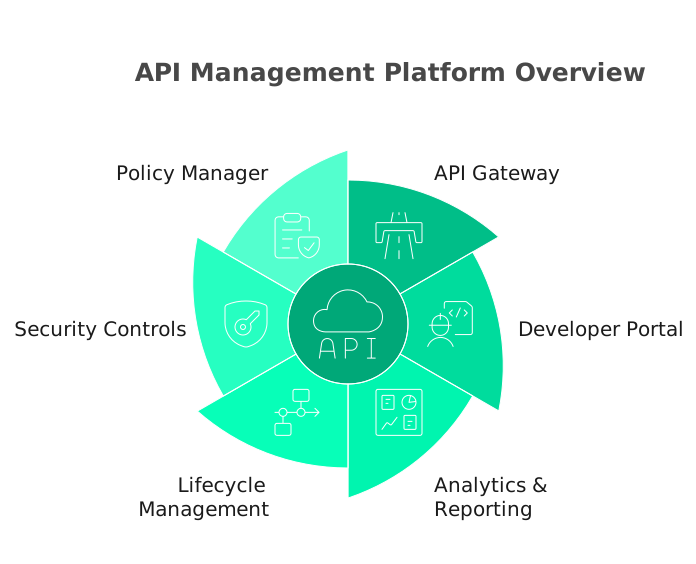
Core components of an API management platform include:
API Gateway
Routes requests, handles authentication, enforces rate limiting, and manages traffic
Developer Portal
Provides interactive documentation, testing sandboxes, and self-service onboarding
Analytics & Reporting
Tracks usage patterns, performance metrics, and business insights
Lifecycle Management
Governs API design, development, testing, deployment, versioning, and retirement
Security Controls
Implements authentication protocols, authorization policies, and threat detection
Policy Manager
Enforces governance rules, compliance requirements, and business policies
Suggested reading:
What is API Management Software? Features, Benefits, and Best Practices
How API Management Works: The Complete Workflow
Understanding how does API management work requires looking at the structured API lifecycle management workflow that governs APIs from creation to retirement. We’ve helped organizations implement this workflow across diverse environments, and the pattern is consistent:
Design → Development → Testing → Deployment → Monitoring → Versioning → Retirement
At each stage, the API gateway plays a central role in managing the technical execution. When a client application makes an API request, the gateway handles authentication (verifying who’s making the request), authorization (checking what they’re allowed to do), rate limiting (preventing abuse), and traffic management (routing to the right backend service). It’s the traffic cop for your digital ecosystem.
The developer portal complements this by providing the human interface interactive documentation using Swagger or OpenAPI specifications, testing sandboxes where developers can experiment without breaking production systems, and self-service onboarding that reduces your support burden. This combination has seen to have reduce time-to-first-API-call by 10X at companies like Moneris.
What’s changing in 2026 is how API management is evolving to support AI agents and autonomous systems. The traditional request-response pattern is expanding to include event-driven architectures, streaming data, and real-time processing all requiring more sophisticated lifecycle governance.
The key to success is centralized governance that provides visibility across your distributed API landscape. You’ll know which APIs exist, who’s using them, how they’re performing, and where security risks lurk. That’s the difference between API lifecycle management that scales and API chaos that doesn’t.
Core Benefits Driving API Management Adoption
When organizations ask about what are the benefits of API management, we point to five proven value drivers backed by real ROI data:

Accelerated Innovation
Bayer achieved a 5X speed increase and 70% process reduction in their integration workflows through effective API management. When developers can discover, test, and integrate APIs quickly through self-service portals, innovation cycles compress dramatically.
Operational Efficiency
AT&T saved 2 million work hours annually by standardizing their API approach and eliminating redundant integration work. That’s real cost savings that goes straight to the bottom line.
Developer Experience
Moneris achieved 10X faster time to first API call by implementing a developer portal with comprehensive documentation and testing sandboxes. Happy developers mean faster integrations and fewer support tickets.
Enhanced Security
Centralized authentication, authorization, and threat detection protect your digital assets. Instead of implementing security controls separately for each API, you’ll enforce consistent API security policies across your entire API landscape through the management platform.
Improved Governance
Unified visibility and policy enforcement ensure compliance with regulatory frameworks. You’ll track who’s accessing what data, enforce data protection rules, and maintain audit trails critical for API governance in regulated industries.
API Monetization
Revenue generation through API-as-Product models is driving adoption, especially as the API monetization market expands. Usage-based pricing, tiered access levels, and developer ecosystem programs turn APIs from cost centers into profit centers.
Is Your Business Struggling to Integrate Systems Seamlessly?
Connect applications, APIs, and workflows effortlessly with end-to-end integration automation. Reduce manual handoffs, sync data in real-time, and create a unified digital ecosystem that scales.
Critical Pain Points API Management Solves
Security Vulnerabilities and Unauthorized Access
API security vulnerabilities represent one of the biggest risks facing organizations in 2026. The OWASP API Security Top 10 identifies critical threats including broken object level authorization, broken authentication, and excessive data exposure all of which can lead to data breaches and unauthorized access.
Here’s what works: 65-70% of enterprises now adopt OAuth and JWT as their standard authentication protocols. OAuth 2.0 handles delegated authorization (letting users grant limited access without sharing passwords), JWT provides stateless token validation (reducing database lookups), and OpenID Connect adds an identity layer on top of OAuth for user authentication.
When we implement API security best practices, we follow this checklist:
API Key Management
Rotate keys regularly, use different keys for different environments, and revoke compromised keys immediately
Rate Limiting
Prevent abuse by limiting request volumes per client, protecting backend systems from overload
Encryption
Use TLS/SSL for data in transit, encrypt sensitive data at rest, and maintain proper certificate management
Threat Detection
Real-time monitoring for anomalous patterns, automated alerts for suspicious activity, and integration with SIEM systems
Audit Logging
Track all API access, maintain immutable logs, and ensure compliance with retention policies
For technical implementation guidance, mastering API gateways for cloud-native environments provides deep insights into API gateway architecture patterns that prioritize security.
The key is understanding how to secure APIs with API management: centralized policy enforcement means you’ll implement security controls once and apply them consistently across all APIs, rather than hoping each development team gets it right independently.

Suggested reading:
API Management Service Pricing: How to Budget for Secure, Scalable APIs
2026 Platform Landscape: Comparing Leading Solutions
Platform Comparison Matrix: Azure vs AWS vs MuleSoft vs Kong
When evaluating API management in Azure versus competitors, you’ll need transparent data on features, pricing, and capabilities. We’ve worked with all four major platforms, and here’s what you need to know:
Azure API Management
$150-$2,800/month pricing across consumption, developer, basic, standard, and premium tiers. Best for organizations already invested in the Microsoft ecosystem it integrates seamlessly with Azure services, Active Directory, and Power Platform. Enterprise features include multi-region deployment, virtual network integration, and self-hosted gateway options.
AWS API Gateway
$3.50 per million API calls with serverless-first architecture. If you’re running on AWS infrastructure, this is your natural choice tight integration with Lambda, CloudWatch, and AWS security services. REST APIs, HTTP APIs, and WebSocket APIs are all supported.
MuleSoft API management
Custom enterprise pricing (typically six figures for large deployments), but with proven ROI. Remember those AT&T and Bayer case studies? That’s MuleSoft. Best for complex enterprise integrations requiring comprehensive iPaaS capabilities, not just API management.
Kong API management
Free open-source version, $500/month Plus tier, enterprise pricing for advanced features. Cloud-native design built for Kubernetes and microservices. Developer-focused with strong community support and extensive plugin ecosystem.
Still Managing APIs Without Central Visibility?
Gain full control over your APIs with advanced monitoring, access management, and automation. Simplify deployment, strengthen governance, and enhance developer efficiency.
Emerging Trends Shaping the 2026 API Economy
AI-Driven API Management and Automation
The $16.29B 2026 API management market s being transformed by AI and machine learning integration. We’re seeing platforms add intelligent capabilities that were science fiction just two years ago.
AI applications reshaping API monitoring and analytics:
Automated Anomaly Detection
Machine learning models baseline normal API behavior and flag unusual patterns traffic spikes, error rate increases, latency changes before they become outages
Predictive Performance Optimization
AI analyzes usage patterns to recommend caching strategies, infrastructure scaling, and traffic routing changes
Intelligent API Testing
Automated test generation based on API specifications, with AI creating edge cases and error scenarios developers might miss
Self-Healing Workflows
When issues are detected, AI can automatically reroute traffic, scale resources, or failover to backup systems without human intervention
The implementation path we recommend: start with monitoring automation (easiest ROI), add predictive analytics for capacity planning (medium complexity), then integrate AI-powered testing (requires more data and training).
Machine learning excels at usage pattern analysis identifying which APIs are underutilized (candidates for retirement), which are approaching capacity limits (need scaling), and which show suspicious access patterns (potential security threats).
For organizations planning their 2026 roadmap, AI-driven API management trends are worth deep exploration this is where competitive advantage will be built.
Building Your API Management Strategy
The transformation from API chaos to API management platform excellence is achievable we’ve guided hundreds of organizations through this journey. The evidence is clear: AT&T saved 2 million work hours annually, Bayer achieved 5X speed increases, and Moneris reduced onboarding time by 10X. These aren’t outliers they’re the expected outcomes when you implement API lifecycle management with the right platform and practices.
The $16.29B market growing at 34% CAGR signals massive opportunity for organizations that get this right. Whether you’re evaluating API management in Azure, AWS API Gateway, MuleSoft API management, or Kong API management, the decision framework is consistent:

1. Assess Current Pain Points:
Security vulnerabilities? Integration complexity? Poor documentation? Versioning chaos?
2. Evaluate Platform Options:
Match capabilities to requirements using our comparison matrix
3. Implement Security-First:
Start with authentication, authorization, and encryption before worrying about advanced features
4. Scale Strategically:
Pilot with high-value APIs, prove ROI, then expand systematically
Looking ahead, what is API management is evolving beyond traditional request-response patterns toward AI automation, event-driven architectures, and API monetization strategies that turn digital assets into revenue streams. The organizations that master this evolution won’t just manage APIs they’ll build competitive advantages that compound over time.
Automate governance, improve security, and accelerate innovation with a unified API management approach. Gain control, reduce costs, and unlock faster integrations.

Frequently Asked Questions
What is the difference between API management and an API gateway?
An API gateway handles routing, authentication, and traffic control. API management includes the gateway plus analytics, developer portals, lifecycle tools, and governance — a complete platform for managing APIs end-to-end.
How much does API management cost in 2026?
Costs vary by platform and scale. Azure API Management starts at ~$150/month, AWS API Gateway at ~$3.50 per million calls, and Kong offers free to enterprise tiers. Enterprises like MuleSoft use custom pricing. Include platform, integration, and support costs in total ROI.
What are the biggest security risks for APIs without management?
Without management, APIs face risks like broken authentication, excessive data exposure, and missing rate limits, all leading to data breaches and DDoS attacks. Centralized API management ensures consistent security, monitoring, and governance.
Which API management platform is best for enterprises vs. SMEs?
Enterprises often choose MuleSoft, Azure API Management, or Kong Enterprise for scale and integration. SMEs benefit from AWS API Gateway, Kong OSS, or Azure’s Developer tier for cost efficiency and flexibility.
How do I measure ROI from API management?
Track key metrics: faster developer onboarding, reduced downtime, improved response times, fewer support tickets, and lower maintenance hours. Compare pre- and post-implementation results to quantify performance gains and cost savings.
